Montag, 5. August 2024

Münchner Oktoberfest 2024 - Countdown: 46 Tage

 189. Münchner Oktoberfest 2024 - Fotos vom Aufbau


FULL HOUSE auf dem 189. Münchner Oktoberfest 2024 - die Betriebe fiebern dem Aufbau und der Wiesn entgegen -Der Countdown läuft: noch 45 Tage und 20 Stunden bis o'zapft wird


Münchner Oktoberfest vom 21. September bis zum 06. Oktober auf der Theresienwiese unterhalb der Bavaria


München. WILLKOMMEN ZUM OKTOBERFEST, so steht es bereits über dem Haupteingang. Dahinter sieht man die Festhallen wachsen - ganze Häuserreihen entstehen ... Die Spannung und die Vorfreude steigen, denn es sind noch 45 Tage und 20 Stunden bis o'zapft wird. Der Countdown auf der offiziellen Website "Oktoberfest.de". Das 189. Oktoberfest steht quasi vor der Tür, jedenfalls bei uns in Minga. Ein Grund für ein paar aktuelle Fotoimpressionen von der Theresienwiese, wo die Bierhallen, Terrassen, Weinhäuser wie Kuffler und Hallen wie die HEIMER Entenbraterei (seit 40 Jahren auf dem Oktoberfest) stetig wachsen, ihre Dächer und Türme erhalten und sogar schon die OIDE WIESN aufgebaut wird. 

Baustelle Münchner Oktoberfest 2024 - noch gibt es grüne Flächen zum Radln und Spielen auf der Wiesn, Foto 4. August 2024, Foto: A. Waess


Los geht es aber erst am 21. September, aber dann darf bis zum 6. Oktober auf der Theresienwiese gefeiert werden

Los geht's dann, wenn Dieter Reiter, der Oberbürgermeister der Stadt München, am 21. September, um 12 Uhr, in der Schottenhamel Festhalle das erste Bierfass anzapft - boarisch: o'zapft!


Augustiner Festhalle hat ihren Turm - Foto: A. Waess


FULL HOUSE auf dem 189. Oktoberfest - viele Betriebe fiebern dem Aufbau und der Wiesn entgegen

Baustelle Münchner Oktoberfest 2024 - Theresienwiese - 4. August 2024, Foto: A. Waess

Insgesamt haben die Verantwortlichen dieses Jahr 470 Betriebe zugelassen:


  • 153 aus der Gastronomie,
  • 123 Schaustellergeschäfte,
  • 194 Marktkaufleute und mehrere Servicebetriebe
Baustelle Münchner Oktoberfest 2024 - Pschorr Brauerei-Halle und Löwenbräu Turm - hinten mittig der Paulaner Maßkrug auf dem Turm, Foto 4. August 2024, Foto: A. Waess

Auf der Oidn Wiesn finden wir dann 41 Betriebe


  • 18 gastronomische Betriebe
  • 23 Schaustellergeschäfte
"Festzelt TRADITION" - Zu Füßen der Bavaria (Bildmitte) wächst die Oide Wiesn auf der Baustelle Oktoberfest, Foto: A. Waess


 Baustelle Oktoberfest


Die gesamte Baustelle Oktoberfest ist mit Bauzäunen abgezäunt. Wer sich vorab schon einmal ein Bild machen möchte, der hat heuer die Möglichkeit bei einer Baustellenführung über die Festwiese dabei zu sein. Jeweils freitags bis sonntags (bis zum 1. September 2024) hat man die Möglichkeit sich in 90 Minuten von den offiziellen "Gästeführern der Landeshauptstadt München" alles zeigen zu lassen.


Paulaner-Turm und Löwenbräuturm - im Hintergrund der Münchner Fernsehturm, rechts: St. Paul im Hintergrund, Baustelle Münchner Oktoberfest 2024 - Theresienwiese - 4. August 2024, Foto: A. Waess


Monaco di Baviera: colazione tradizionale con salsiccia bianca come “bene culturale” - un classico bavarese

Un must: la tradizionale colazione con salsiccia bianca a Monaco
 
COME MANGIARE A MONACO: Weisswurst con senape dolce, un pretzel e una birra di frumento sono un classico della colazione a Monaco - i bavaresi amano i cibi salati


Weisswurst è un bene culturale in Baviera!!! (INGLESE, Tedesco

Monaco di Baviera: una città cosmopolita con un cuore! ... anche il cibo deve essere sostanzioso. Nella Hofbräuhaus (Platzl 9, 80331 M.) anche i locali sentono l'atmosfera dell'Oktoberfest. Ma per favore: cari ospiti della città di Monaco, non ordinate il ketchup con il vostro Weißwurst e attenetevi al galateo del Weißwurstverzerr, che vorremmo presentarvi di seguito. Perché il piatto nazionale, che per tradizione viene servito solo fino alle 12, è un “bene culturale”!!! La vera colazione bavarese con salsiccia bianca prevede anche un pretzel, una deliziosa senape dolce e una bella birra di frumento fresca (è disponibile anche analcolica) - a volte vengono serviti prezzemolo e ravanelli. Se vuoi puoi ordinare anche un Obazda. Del resto qui la birra di frumento è una buona base per la colazione con salsiccia bianca, perché il grasso lubrifica lo stomaco e il pretzel assorbe l'alcol.

Le prelibatezze bavaresi sono abbondanti: qui vengono servite nel tendone del festival, foto: A. Waess


Cosa mangiare a Monaco? Cibo bavarese originale


Se volete provare la cucina bavarese originale, vi consigliamo anche piatti tipici come il Leberkäs, lo stinco di maiale, gli gnocchi di patate bavaresi, l'Obazda, le polpette di carne bavaresi, il cavolo bavarese e, con una tazza di caffè, i datschi bavaresi di prugne. Ovviamente uno di questi piatti tutti i giorni e non tutti in una volta!!! A proposito, esiste anche una tradizionale colazione artigianale o “seconda colazione” composta da un pretzel al burro o un panino al fegato. Recentemente molto richiesto anche come Leberkäs kebab o kebab artigianale.


Atteniamoci prima alla colazione con salsiccia bianca


In questo paese esiste un comandamento bavarese per la Weißwurst: "Mangia la Weißwurst prima di mezzanotte!" Secondo l'antica usanza non le è permesso sentire suonare la mezzanotte dal campanile della chiesa. Il motivo? In passato la salsiccia bianca veniva preparata fresca al mattino e subito venduta cruda.

Quindi assicurati di mangiare prima di pranzo! 


MA: Nell'Augustiner Bräustuben (Landsberger Straße 19, 80339 M.) gli orari di servizio della Weißwurst sono più lunghi - perché nell'Augustiner Bräustuben la Weißwurst viene servita fino alle 13:00.

Le prelibatezze della cucina bavarese tentano con piatti tradizionali, qui nel tendone del festival! Archivio foto stampa: Helga Waess


Com'è la salsiccia bianca a Monaco?


Se osiamo gustare una salsiccia bianca, è necessario tenere conto di quanto segue:


Come spuntino mattutino tradizionalmente si ordinano salsicce bianche di Monaco con senape dolce, pretzel e birra di frumento.

La salsiccia bianca è ricoperta da un budello naturale. Puoi mangiarlo, ma è un guscio duro che è più facile da staccare. Nei ristoranti e nei saloni delle feste le salsicce vengono servite in una ciotola di acqua calda, altrimenti la pelle scolorirebbe raffreddandosi sul piatto. Spellare la salsiccia calda non è così facile! Ma il Bayern ha i suoi metodi:

1. Una vera "zuzelt" bavarese

Ciò significa che aspirano con attenzione l'interno della salsiccia e le parti commestibili dalla pelle aperta ad un'estremità! Quindi prendete la salsiccia bianca con la mano e tritatela. La parte interna della salsiccia, la carne, viene espulsa dall'intestino mediante la pressione negativa della lingua e l'uso molto delicato dei denti e finisce direttamente in bocca. Naturalmente la salsiccia viene prima immersa nella senape dolce. Non è così facile comprimere senza perdere la tua storia; Perché se mordi troppo, questo metodo risulta antiestetico o, meglio ancora, poco appetitoso per la compagnia della tavola.


2. Tagliare longitudinalmente con una forchetta e un coltello affilato


Poiché non è così semplice - e ad alcuni non sembra così appetitoso - potete anche fare un taglio longitudinale con un coltello affilato e piegare di lato il budello con la forchetta! Per favore, fai tutto senza mettere le mani sulla salsiccia. Quindi togliamo le metà della salsiccia! Ora la carne della salsiccia può essere tagliata a pezzetti fini e gustata con senape dolce. 


3. Il taglio trasversale della salsiccia bianca è un'opzione gastronomica nobile


Il taglio trasversale è un po’ più complicato ed è sempre ammirato:

Tagliamo la salsiccia in diagonale e liberiamo la carne dalla pelle dura con un movimento rotatorio! Quest'ultimo rimane sul piatto senape con motivo a rombi. 

Otterrai ammirazione con questa abilità. Ma non è così facile!

A proposito, le migliori salsicce bianche si trovano nella Sendlinger Gaststätte Großmarkthalle (Kochelseestraße 13, 81371 M.)


A proposito, nella locanda “Gaststätte Großmarkthalle” di Monaco troviamo Wallner, che come locandiere viene scherzosamente chiamato dai suoi ospiti anche “il papa della salsiccia bianca di Monaco”. Gli intenditori e gli appassionati di salsicce vengono qui solo per la colazione con la salsiccia bianca, dove le salsicce bianche vengono preparate fresche ogni giorno in casa.


 Sulla storia della salsiccia bianca di Monaco:


La salsiccia bianca di Monaco fu inventata, secondo la leggenda, dal macellaio della locanda Joseph Moser nella locanda “Zum Ewigen Licht” sulla Marienplatz di Monaco, la domenica di carnevale del 1857: era una salsiccia difettosa.


Anche altri piatti sostanziosi sono allettanti!


Ricco rosti di canederli con pollo, cipolle fritte e pretzel, foto: Helga Waess


E: nella stagione delle prugne - agosto, settembre fino a metà ottobre - i datschi di prugne di Augusta con pasta lievitata sono particolarmente appetitosi per gli abitanti di Monaco

  •     menzionato per la prima volta nel libro di cucina di Augusta di Sophie Weiler del 1787


Qui le prugne sono pronte per la torta - Foto: Helga Waess


München: Traditionelles Weißwurstfrühstück als "Kulturgut" - ein bayerischer Klassiker

Ein Muß: Traditionelles Weißwurstfrühstück in München


WIE ISST MAN IN MÜNCHEN: Weißwurst mit süßem Senf, einer Breze und einem Weißbier sind ein Frühstücksklassiker in München - Bayern lieben Herzhaftes


Weißwurst ist in Bayern  ein Kulturgut!!! (ENGLISH)


München - Weltstadt mit Herz! Willkommen in München ... auch bei der Speise muss es  hier Herzhaft sein. Im Hofbräuhaus (Platzl 9, 80331 M.) kommt selbst bei Einheimischen das ganze Jahr über ein Wiesngefühl auf. Aber bitte: Liebe Gäste der Stadt München, bestellt keinen Ketchup zur Weißwurst und haltet euch an die Ettikette des Weißwurstverzerrs, die wir unten gerne vorstellen. Denn bei dem Nationalgericht, das traditionell nur bis 12 Uhr serviert wird, handelt es sich um ein "Kulturgut"!!! Das echte bayerische Weißwurstfrühstück braucht auch eine Breze, den leckeren süßen Senf und ein schönes, frisches Weißbier (gibt es auch Alkoholfrei) - manches Mal werden Petersilie und Radieschen dazu serviert. Wer möchte bestellt auch einen Obazda. Weißbier ist übrigens hier eine gute Grundlage für das Weißwurstfrühstück, denn: Fett schmiert den Magen und die Breze saugt den Alkohol auf.

Bayerische Schmankerl sind deftig - hier werden Sie im Festzelt serviert, Foto: A. Waess


Was muss man in München gegessen haben? Original Bayerisches Essen


Wer original Bayerisches Essen ausprobieren möchte, dem seien auch typische Gerichte wie Leberkäs, Schweinshaxn, Bayerische Kartoffelknödel, Obazda, Bayerische Fleischpflanzerl, Bayerisch Kraut und zum Haferl Kaffee dann Bayerischer Zwetschgendatschi empfohlen. Natürlich an jedem Tag eines dieser Gerichte und nicht alles auf einmal!!! Übrigens gibt es auch ein traditionelles Handwerkerfrühstück oder „zweites Frühstück“ bestehend aus einer Butterbrezen oder einer Leberkässemmel. Neuerdings auch als Leberkäs-Döner beziehungsweise Handwerker-Döner heiß begehrt.


Bleiben wir zunächst beim Weißwurstfrühstück


Für die Weißwurst gibt es hierzulande ein Bayerisches Gebot: "Die Weißwurst vor 12 Uhr essen!" Sie darf nach altem Brauch das Zwölf-Uhr- Läuten vom Kirchturm nicht hören. Der Grund dafür? Früher wurde die Weißwurst frisch in der Früh zubereitet und sofort roh weiter verkauft. 

Also bitte unbedingt vor dem Mittag essen! 

ABER: Die Augustiner Bräustuben (Landsberger Straße 19, 80339 M.) haben längere Weißwurstservierzeiten - denn in den Augustiner Bräustuben wird die Weißwurst sogar bis 13 Uhr serviert.

Die Bayerische Schmankerlküche lockt mit traditionellen Speisen, hier im Festzelt! Foto-Pressearchiv: Helga Waess


Wie ist man in München eine Weißwurst?

Wagen wir uns an den Genuß einer Weißwurst, dann ist folgendes zu beachten:


Münchner Weißwürste also traditionell mit süßem Senf, Brezn und Weißbier am Vormittag als Brotzeit bestellen. 

Die Weißwurst wird von einem Naturdarm eingehüllt. Man könnt ihn zwar mitessen, aber es handelt sich hier um eine zähe Hülle, die man besser abzieht. Die Würste werden in den Gaststätten und Festhallen in einer Schüssel mit heißem Wasser serviert, da sich die Haut beim Abkühlen auf dem Teller sonst vorab verfärben würde. Das Enthäuten ist bei der heißen Wurst garnicht so leicht! Aber die Bayern haben da so ihre Methoden:

1. Ein echter Bayer zuzelt

Das bedeutet, dass sie das Wurstinnere vorsichtig und ihn essbaren Portionen aus der an einem Ende geöffneten Haut heraussaugen! Die Weißwurst also mit der Hand nehmen und zuzeln. Das Innere der Wurst, das Brät wird dabei mit Unterdruck, mit der Zunge und mit ganz sanftem einsatz der Zähne aus dem Darm gedrückt und landet direkt im Mund. Vorher wird die Wurst natürlich in den süßen Senf getunkt. Zuzeln ist nicht so einfach, ohne sein Geschicht zu verlieren; denn, wenn man zu fest beißt wirkt dies Methode auch unästhetisch oder besser für die Tischgesellschaft unappetitlich.

2. Längsschnitt mit einer Gabel und einem scharfen Messer

Weil das nicht so einfach ist - und manch einem auch nicht so appetitlich erscheint, kann man mit einem scharfen Messer auch einen Längsschnitt anlegen und die Hülle seitlich mit der Gabel wegklappen! Alles bitte ohne die Hände an die Wurst zu legen. Dann lösen wir die Wursthälften heraus! Nun kann das Brät in feine Stücke geschnitten und mit süßem Senf genossen werden.

3. Der Kreuzschnitt der Weißwurst ist eine noble Verzehrvariante

Der Kreuzschnitt ist etwas komplizierter und findet immerwieder Bewunderung:

Wir schneiden die Wurst schräg an und befreien das Brät mit einer Drehbewegung von seiner zähen Haut! Letztere bleibt als Rautenmuster auf dem Senf-Teller liegen. 

Sie werden mit dieser Fertigkeit Bewunderung ernten. Aber: das ist nicht so einfach!


Die besten Weißwürste gibt es übrigens in der Sendlinger Gaststätte Großmarkthalle (Kochelseestraße 13, 81371 M.) 

Im Wirtshaus "Gaststätte Großmarkthalle" finden wir in München übrigens den Wallner, der als Wirt auch spaßeshalber von seinen Gästen „Weißwurstpapst Münchens“ genannt wird. Kenner und Wurstfans kommen extra nur zum Weißwurstfrühstück hierher, wo die Weißwürste sogar im Haus täglich frisch hergestellt werden.

 Zur Geschichte der Weißwurst aus München:

Die Münchner Weißwurst wurde - so erzählt man - vom Wirtsmetzger Joseph Moser im Gasthaus „Zum Ewigen Licht“ am Münchner Marienplatz im Jahr 1857 am Faschingssonntag  erfunden – sie war ein Bratwurst-Fehlfabrikat. 


Andere deftige Speisen locken ebenfalls!


Herzhafte Knödel-Rosti mit Hendl und Röstzwiebeln und Breze, Foto: Helga Waess


Und: in der Zwetschgensaison - August, September bis so Mitte Oktober - schmeckt dann der Augsburger Zwetschgendatschi mit Hefeteig den Münchnern besonders gut

  • erstmals im Augsburger Kochbuch von Sophie Weiler aus dem Jahr 1787 erwähnt
     

Hier sind die Zwetschgen bereit für den Kuchen - Foto: Helga Waess


Sonntag, 4. August 2024

Excursion and gastronomy tip: Fishing Sebald in Ammerland on Lake Starnberg

Leisure tip: Fresh fish in Ammerland - directly from Lake Starnberg


PURE IDYL at the gates of Munich: small forests, green meadows and in the distance the Alps and then Lake Starnberg with fresh fish in the snack garden


Ammerland - Hubert without Staller - Graf bakery - Graf Pocci - Sebald fishing (snack garden with boat rental) and the lake shore including bathing beaches with an Alpine backdrop


 Münsing - Ammerland on Lake Starnberg (today 24 degrees water temperature). We drive from the beautiful Bavarian capital Munich south, Solln, Pullach and then soon towards Wolfratshausen and Münsing to Lake Starnberg. Small forests, green meadows and the Alps and above all the wide, blue sky with bright sunshine. We roll through Icking, Dorfen towards Höhenrain and then on via Münsing towards Ammerland. The Munich locals' insider tip for fresh fish right on the lake... and then swim into the water and towards the Alpine scenery!

Drive through the Oberland from Munich towards Münsing with a view of the Alps - April 27, 2024, Photo: Helga Waess (from the passenger seat)


Ammerland and the bavarian TV-crime series “Hubert and Staller” and later “Hubert without Staller”


The town of Ammerland has become famous beyond the borders of the Bavarian Oberland, not least because of the crime series “Hubert and Staller” and “Hubert without Staller”.

The Graf bakery is renamed the Rattlinger bakery as the location for every film shoot for the crime series.

Here you can sit outside when the weather is nice and enjoy the best cake on the lake (editor's opinion): fresh and baked on site by master baker Hubert Graf and his nice master baker.

None other than Loriot has immortalized himself in writing here in the bakery. - By the way, Loriot also got the beautiful fountain monument in Münsing by the small park: a bathtub for Loriot. See the photos in our article: Loriot's 100th birthday - memory of Loriot. LORIOT - Vicco von Bülow - lived with his pugs in Ammerland on Lake Starnberg. On November 12, 2023, the grand master of middle-class humor Loriot would have been 100 years old - in German: Loriots 100. Geburtstag - Erinnerung an Loriot. LORIOT - Vicco von Bülow - lebte mit seinen Möpsen in Ammerland am Starnberger See. Am 12. November 2023, wäre der Großmeister des gutbürgerlichen Humors Loriot 100 Jahre alt geworden


Car ride from Munich towards the Alps - on narrow country roads, photo: Helga Waess (from the passenger seat)


A scenic route towards Lake Starnberg promises a day of vacation


The village of Münsing also includes the small, idyllic town of Ammerland, which is characterized by the traditional Graf bakery, the castle of the Counts Pocci, the garden of the Sebald court fishery on Lake Starnberg and, last but not least, by the loss of the beautiful steamer jetty at the "Hotel am See" - a few years ago years ago - is still known to many people.


Die SEESHAUPT legte unter anderem am Dampfersteg in Ammerland an - hier 2018 unser Archivfoto, Foto-Pressearchiv: Helga Waess / The SEESHAUPT docked at the steamer jetty in Ammerland, among other places - here is our archive photo from 2018, photo press archive: Helga Waess


The steamer pier will be sorely missed by locals and guests.


By the way, Count Pocci was the father of Kasperl Larifari! 

(Author of the world-famous Punch and Judy show)


And his summer palace was here in Ammerland. For 30 years, Ammerland on Lake Starnberg was Franz Graf von Pocci's home. A visit to Ammerland on Lake Starnberg allows you to experience the idyll in which Franz Graf von Pocci grew up.

The Ammerland Castle Chapel (built in 1683) belongs to the Pocci Castle - on the Nördliche Seestrasse, photo: A. Waess


Francis of Pocci


The little and later big Franz spent 30 years of his life here. What might it have been like a good 200 years ago for the child Franz von Pocci when piano, lessons and drawing lessons regulated the day at Lake Starnberg?

 There was certainly time for the lake and the forests. So it is not surprising that childhood and children play a major role in his later writing and drawing work.

About Count Pocci - here is our article: Pocci is far, far more than a street name and a subway station in Munich - The exhibition “Franz von Pocci and Humor” shows the royal court official as a caricaturist and puppet count - in GERMAN: Pocci ist weit, weit mehr als ein Straßenname und eine U-Bahn-Station in München - Die Ausstellung „Franz von Pocci und der Humor“ zeigt den königlichen Hofbeamten als Karikaturist und Kasperlgraf


There are some shore areas on Lake Starnberg that belong to the communities and are freely accessible - lake shore in Ammerland, photo: A. Waess


 The Sebald fishing master family has been based in Ammerland for generations - with boat rentals


In the farm shop you can buy everything you need for a good fish meal. All fish specialties are available either to take away or on plates for direct consumption in the picturesque snack garden.  The lovingly designed garden invites you to linger and after the fish meal there are delicious, fresh cakes and coffee.

  • A little TIP: Only on Thursdays there are fresh, homemade fish cakes


 Opening times in summer (April 1st to October 31st):
Monday closed, Tues-Sat: 8:00 a.m. - 6:00 p.m., Sundays and public holidays: 9:00 a.m. - 6:00 p.m. / Boat rental: www.bootsverleih- fishing.de


The fisherman's decoration ranges from small jetties to converted rowing boats, photo: A. Waess

Samstag, 3. August 2024

Klick-Ranking für den Monat Juli 2024

 Top-Themen in unserem Blog


Kunst-Kultur-Blog: Heute stellen wir das Klick-Ranking für den Monat Juli 2024 vor


Klickranking im Kunst-Kultur-Blog  Platz  1

  München: Denkmal für Michael Jackson - Orlando di Lasso .  Denkmal des KING OF POP : Michael Jacksons Andenken in München- Michael Jacksons Andenken in München. Der KING OF POP war nicht oft in München, aber wenn er für ein Konzert vorbeischaute, dann residierte er am Promenadeplatz im Hotel Bayerischer Hof, dem ersten Hotel am Platz


München - Cover Kunst-Kultur-Blog, Foto: H. Waess

Klickranking im Kunst-Kultur-Blog  Platz 2

 Munich celebration tip - Munich tradition: The Auer Dult 2024 at Mariahilfplatz untill August 4th, 2024 . Folk festival in the Au in Munich: fun, beer gardens and various stands, rides, play stalls, activities and more on the Auer Dult -  Except Dult! The summer Jakobidult will take place from July 27th to August 4th, 2024
Every visitor to Munich should know this folk festival: It is the oldest festival in Munich: the traditional Auer Dult.


Klickranking im Kunst-Kultur-Blog  Platz 3


 Museen in München - Sommer-Ferienprogramm 2024: Im August gibt es ein buntes Sommerferien-Programm in den Münchner Museen


Klickranking im Kunst-Kultur-Blog  Platz 4 

 
 München Freizeit-Tipp: bis 18. August: Konzerte im Brunnenhof der Residenz. Sommer-Konzerte 2024 im Brunnenhof der Residenz am Odeonsplatz in München . München-Konzert-Tipp: Zeitlose Klassiker von Vivaldi, ABBA, Queen, Spider Murphy Gang, Tina Turner als Open-Air-Konzerte im Brunnenhof der Residenz der bayerischen Könige im Herzen der Landeshauptstadt - Konzert-Sommer in München - hier 2. bis 18. August - Open Air Konzerte im Brunnenhof der Münchner Residenz


Freitag, 2. August 2024

München feiert: Auer Dult noch bis zum 4. August 2024

 Münchner Tradition: 9 Tage Auer Dult 2024 am Mariahilfplatz - hier feiert ganz München ein kleines Oktoberfest


Volksfest in der Au in München: Spaß, Biergärten und diverse Standln, Fahrgeschäfte, Spielbuden, Aktionen und mehr auf der Auer Dult (English, Français)


 Auer Dult! Vom 27. Juli bis 4. August 2024 findet die sommerliche Jakobidult statt


München. Jeder Münchenbesucher sollte dieses Volksfest kennen: Es ist das älteste Fest Münchens: die traditionelle Auer Dult. Erstmals fand sie im Jahr 1310 statt. Das schöne Münchner Volksfest dauert noch bis zum 4. August. Jedes Jahr sind circa 300 Händler, Künstler und Kunsthandwerker, Schmankerlbudenbetreiber und Schausteller bei diesem schönen Volksfest in München dabei. In München genießt man die Feste wie sie kommen. Bis zum 04. August 2024 findet wieder diese kleine Wiesn in der Au statt. Veranstaltet wird die Auer Dult dreimal jährlich! Alle treffen sich dann auf dem Mariahilfplatz (östlich/rechts der Isar gelegenem Stadtviertel Au) und gefeiert wird genau neun Tage. Auf der alljährlichen Jakobidult feiert man mit Spezialitäten-Buden, in Biergärten und mit Kunsthandwerkern. Groß und Klein finden Erfrischung, Spaß und Abwechslung.

Münchner Rathaus und Türme der Frauenkirche mit den typischen "Welschen Hauben", Photoarchiv: Helga Waess


 Familienspaß für die ganze Familie auf der Auer Dult


Autoscooter, Ringwerfen, Ballwerfen, Kinderkarussell aber auch Kasperl und Co erwarten die Besucher auf der Auer Dult. Es riecht wie beim Oktoberfest und man nascht Zuckerwatte und gebrannte Mandeln.
Also vor dem Start in die großen Sommerferien in Bayern auf zur beliebten Münchner Jakobidult, denn am Dienstag, 30. Juli 2024, gibt es auch noch ermäßigte Preisen im Schaustellerteil.


Die Auer Dult ist jedes Jahr der Markt

... für Unikate von Kunsthandwerkern wie Teppich-Knüpfern, Holzschnitzern oder Keramikern, aber man findet auch antiquarische Bücher, bayerische Schmankerl und Biergärten sowie Karussells. Die Auer Dult ist eine traditionelle Dult in München. 


Insgesamt finden im Jahr folgende Feste in der Au statt

Die Maidult vor dem 1. Mai, die Jacobidult nach dem Jakobifest am 25. Juli und die Kirchweihdult vor dem Kirchweihfest, das immer am dritten Sonntag im Oktober stattfindet. 


Kulinarisch findet man auf der Auer Dult alle bayerischen Spezialitäten

Zur Auer Dult auf dem Mariahilfplatz gibt es an allen Ecken Schmankerl von süß bis deftig. Das gute Essen und Trinken gehört in München einfach zum Fest. 

Bayerische Schmankerl-Highlights

  • frische Rahmschmankerl
  • Sandwiches mit marinierten Ochsenfetzen
  • typische Schupfnudeln - hier aus der großen Pfanne
  • Steckerlfische sind ein Muss für jeden Besucher
  • bayerische Stockwürste (werden selten serviert und ähneln den Weißwürsten)
 

Vegetarische und vegane Speisen


  • typische Käsespätzle 
  • und köstliche Antipasti-Sandwiches


Öffnungszeiten der Jakobidult 2024

  •     Täglich von Samstag, 27. Juli bis Sonntag, 5. August 2024
  •     Verkaufszeiten von 10 bis 20 Uhr
  •     Fahrgeschäfte von 10:30 bis 20 Uhr  
  •     Familientag am Dienstag, 30. Juli - ermäßigte Preise im Schaustellerteil


LOCATION der Auerdult - Volksfest in München bis 04. August 2024

Mariahilfplatz (östlich/rechts der Isar gelegenem Stadtviertel Au)

Donnerstag, 1. August 2024

Munich: 2. August - Fountain Festival at the Viktualienmarkt

 Munich: August 2, 2024 is the fountain festival at the Viktualienmarkt


Celebration tip: Fountain Festival in the living room of the city of Munich, the Viktualienmarkt - take part in a piece of Munich's “cultural tradition”


Traditions count at the Viktualienmarkt: “Munich Fountain Festival on the Viktualienmarkt” -  the celebration on August 2nd, 2024 will attract half of Munich to the old town from 12:00 p.m. to 5:00 p.m


Munich - Viktualienmarkt.
The celebrations take place on August 2nd in Munich. Everything comes together at the fountain festival on Munich's Viktualienmarkt in the heart of the old town. It is just a few steps from Marienplatz to the most famous market square in the Bavarian capital. The stalls and the market women have long been world-famous and are a must for locals and tourists from all over the world. There you will experience “A Gaudi on every corner”. Today's Friday traditionally belongs to the “living room of the city”, the Viktualienmarkt. It is a festival that is intended to commemorate a time between 1860 and 1920, the great era of folk singers and actors in Munich. A few years ago (2010) a new tradition was founded at the Viktualienmarkt called the “Fountain Festival” that has been very well received. Homepage: www.brunnenfestviktualienmarkt.de .... Munich's fountain reminds us of so-called Munich originals who were given a place in the heart of the city as fountain figures: they are folk singers and comedians such as Karl Valentin, Weiß Ferdl, Liesl Karlstadt, Ida Schumacher , Elise Aulinger and the Roider Jackl who received specially decorated fountains this year on the first Friday in August. Musicians, artists and actors perform alongside festively colored fountains. The audience experiences drama, readings, singing and dancing.


Fountain festival on the Viktualienmarkt in Munich,
Photo: H.Waess (press archive)

If you would like to be there, please keep the first Friday of August 2024 free tomorrow if you would like to take part in a piece of Munich's “cultural tradition discovery”

A day on which the market stalls also have treats available to encourage people to get to know regional specialties.


 The beer garden at the Viktualienmarkt - you can bring food with you - drinks can be bought from the innkeeper!


When the weather is nice, the Brunnenfest is an opportunity to visit the most beautiful and central beer garden in downtown Munich. You can sit here comfortably under the old, shady chestnut trees, drink something cool and relax after or before your shopping trip, which is always something special in Munich city center from Kaufingerstrasse to the Fünf Höfe to the noble Maximilianstrasse.

Australian calves at the fountain festival,
Photo: A. Waess (press archive)

Today we enjoyed the “Elderstandl”, which is somewhat hidden (to the right of “Nordsee”)


 We tried sea buckthorn, strawberry and elderberry syrup. Everything is homemade and delicious. A little sea buckthorn syrup in the glass and poured with mineral water, it looks like beer and is a great thirst quencher.
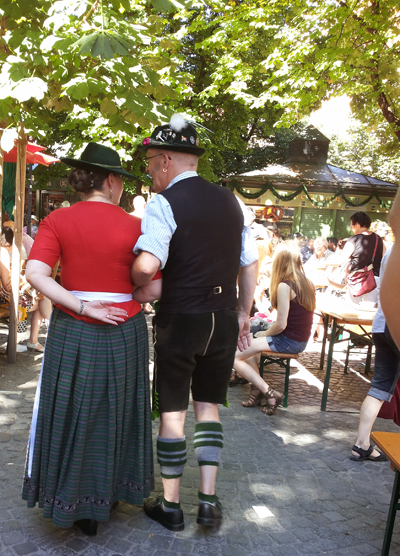
People sing, celebrate and dance at the Brunnenfest, photo: H. Waess (press archiv)


 On the Viktualienmarkt there are several fountains spread throughout the market area


 Most of the fountains are named after singers and personalities. Even throughout the year, the fountains are repeatedly decorated by the market people - one or two figures have a few flowers in their hands.


Maypole on the Viktualienmarkt
Photo: H.Waess, press photo archive


Elise Aulinger Fountain


In 1977, Elise Aulinger also received her fountain on the Viktualienmarkt. She probably invented Ratschkathi and enriched the “Münchner Luft” operetta as market woman Veronika Wurzl.
The music plays at the fountain festival,
Photo: A. Waess - press photo archive


White Ferdl fountain


The Weiß Ferdl is located directly at the Viktualienmarkt beer garden. His widow Bertl Weiß once let him splash for the first time.

Viktualienmarkt in Munich - the city's living room - Photo: H. Waess - Press photo archive


Roider Jackl fountain


Jakob Roider went down in Munich history as a folk singer with his Gstanzl. A forester by profession, he appeared at strong beer festivals such as the Salvator tapping at Nockherberg.


Liesl Karlstadt fountain


Liesl Karlstadt was the pseudonym for Elisabeth Wellano, who, as an actress and cabaret artist, formed the comedian duo with Karl Valentin.


Historical costumes in Munich on the Viktualienmarkt, the living room of the Bavarian capital, photo: Helga Waess (Archive)


Karl Valentin fountain


The Karl Valentin Fountain has been flowing water for the Munich comedian and folk singer (1882 - 1948) since 1953. Valentin played many pieces with Liesl Karlstadt. The museum in the Isartor was set up for both.


Ida Schumacher fountain

Ida Schumacher came from Lower Bavaria and was a theater actress and comedian. Her role as Ratschkathi with a bucket and broom is well known. We find this fountain very close to the maypole.


Ida Schuhmacher fountain with historical folk singers,
Press photo archive: A. Waess 


Traditional costumes from the 19th century
Press photo archive H. Waess

The potato fountain


It is very inconspicuous and provides drinking water all year round.


The sleeping tree between the Schrannenhalle and the city museum offers enough shade for a break on hot days, Photo: H. Waess - press photo archive


The honey fountain


No, there is no honey here, but the “Honigfrau” has her “Honighäusl stand” very close by.


A little dance in traditional costume and the sun is shining!
Photo: H. Waess press photo archive


You can see a few impressions from the “living room of the city”, from the fountain festival on the Viktualienmarkt, on the traditional homepage:


    www.brunnenfestviktualienmarkt.de/