International Day of Forests was on March 21st
The forest will grow in Germany! The forestry authorities see the best conditions for the forest of tomorrow - every tree planting day is a day for the forest!
Beech, maple, larch, Douglas fir and many other tree species will grow into mixed forests in our forests in the future (GERMAN)
Northern Germany. March 21st was International Forest Day. The forest will grow! The forestry authorities see the best conditions for the forest of tomorrow - every tree planting day is a day for the forest! The forests in Germany took March 21st as an opportunity to officially start the planting season, in which the Lower Saxony state forests alone have already planted over 5.5 million seedlings - since autumn. The "weather conditions and soil conditions could hardly be better at the moment: frost and snow were largely absent and the heavy rainfall has moistened the ground well." Anyone traveling in northern Germany knows the Harz low mountain range, which borders Lower Saxony, Saxony-Anhalt and Thuringia, and knows that it is high time for a green new start, because bark beetles, storms and drought had taken a toll on the once lush greenery and entire tree regions were dying let.
 |
Forest path with fresh spring green - Photo: A. Waess
|
The “Hart”, the medieval name of the Harz, has always been a dense mountain forest
That's what it should be again: The focus of reforestation at the Lower Saxony State Forestry is, among other things, in the Harz National Park. In this beautiful, extensive hilly area around the Brocken alone (at a height of 1,141.2 m above sea level it is the highest mountain in the Harz low mountain range), over 2.2 million seedlings were planted in the mixed forest: beech, maple, larch, Douglas firs and various other tree species. “In just a few weeks, the fresh green shoots will reveal the new forest,” says Dr. Klaus Merker, President of the Lower Saxony State Forests.
 |
Forest path in February - Photo: A. Waess
|
The planting program increasingly relies on various mixed tree species
Mixed forests are much better prepared for climate change than pure coniferous forests.
“Here, where the forest is apparently still intact, we can plant the next generation in the protection of the crowns of old pine trees and thus initiate change early and in an ecologically careful manner,” emphasizes Dr. Merker the forest conversion program of the Lower Saxony State Forests. Mann relied on innovative processes here: “... planting small seedlings with bare roots was the standard for decades, but now small plants with root balls are also being used... “While people once worked by hand, i.e. with a planting hoe or spade, this is now done Cordless earth drill and planting tube used. “Planting these so-called container plants has many advantages: They are less susceptible to spring drought and are also easier to plant,” says Dr. Marker. Due to their size, some of the seedlings can only be planted with an excavator. By the way, due to their height, they are protected from being eaten by mice or other wild animals.
Light-seeded tree species such as silver fir
Then the excavator or former wood harvesting machines are also used for planting. which prepare the seedbed in just one step. You can also use light-seeded tree species such as silver fir at the same time.
 |
Natural forest floor in spring - Photo: A. Waess
|
We look forward to long walks through the nearby forests
There are around 10.7 million hectares of forest in Germany, which means an area of 29.8 percent of the total area is covered by around 90 billion trees.
So at the weekend we'll go into the forest again, because the Bavarian Forest, Black Forest, Palatinate Forest and the Harz low mountain range, the Hainich National Park, the Teutoburg Forest, the Thuringian Forest as well as the Darß Forest and many other forests are waiting for their visitors.
 |
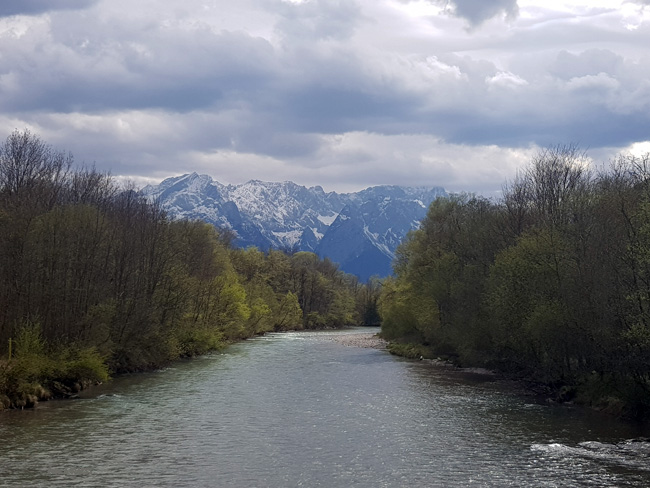
Isar with Alps in spring - Photo: A. Waess
|
The “International Day of Forests”
... by the way, was launched in 1971. The Food and Agriculture Organization of the United Nations (FAO) thus set the international framework for an international “Day of the Forest”.
 |
| Wildflowers on the forest floor in spring - Photo: A. Waess |
The forest will grow!
The forestry authorities see the best conditions for the forest of tomorrow
- every tree planting day is a day for the forest!
 |
Forest path with fresh spring green - Photo: A. Waess
|